Tools
The Tools section holds financial calculators for modeling and analysis, plus an Export area with downloadable spreadsheet and presentation templates. Each calculator has interactive inputs and results that update as you type, with charts or tables where useful.
Time Value of Money
- PV / FV Annuity: present or future value of a stream of regular payments, with ordinary or annuity-due timing and a choice of compounding frequency.
- Compound Interest: model investment growth with regular contributions.
- Doubling Rule: time to reach a target multiple, including the Rule of 72 and Rule of 69.3, and the rate needed to double over a given horizon.
The distinction between ordinary and annuity-due timing is when each payment lands. An ordinary annuity pays at the end of each period, which is the usual convention for bond coupons and most loans. An annuity-due pays at the start of each period, as rent and many subscriptions do. Because every annuity-due payment sits one period earlier, it spends more time earning interest, so an annuity-due is worth more than an otherwise identical ordinary annuity.
The doubling rules are shortcuts for how long money takes to double at a fixed growth rate. The Rule of 72 divides 72 by the percentage rate to estimate the number of periods, and works well for the mid-single-digit rates common in finance. The Rule of 69.3 uses the exact figure from continuous compounding and is more accurate at low rates. Both approximate the same idea and save you from solving the growth equation directly.
Fixed Income
- Bond Pricing: price a bond from its face value, coupon, maturity, and market yield. Shows current yield, duration, convexity, and the price/yield curve.
- Yield Calculator: solve for yield to maturity, yield to call, and yield to worst, including callable bonds.
- Convertible Bond: analyze a convertible bond's straight-bond value, conversion value, conversion premium, and break-even.
A bond's price and its yield move in opposite directions: when the market yield rises, the fixed coupons are discounted harder and the price falls. Duration measures how sensitive the price is to that yield change, expressed as the approximate percent change in price for a one-percentage-point move in yield. A longer duration means a more rate-sensitive bond. Convexity captures the fact that this relationship is not a straight line. The price/yield curve bows outward, so price rises faster as yields fall than it drops as yields rise by the same amount. Duration alone understates gains and overstates losses on large moves, and convexity is the correction for that curvature.
The three yield measures answer different questions about a callable bond:
- Yield to maturity (YTM): the return if you hold the bond to its maturity date and every payment arrives as scheduled.
- Yield to call (YTC): the return if the issuer redeems the bond at the earliest call date instead of letting it run to maturity.
- Yield to worst (YTW): the lowest of the maturity and call outcomes, so it shows the least favorable yield the issuer can hand you by choosing when to redeem.
A convertible bond can be held for its coupons or exchanged for a set number of shares, and the calculator separates those two sides. The straight-bond value is what the bond is worth on its cash flows alone, ignoring the conversion right, which acts as a floor. The conversion value is what the shares would be worth if you converted today. The conversion premium is how much more the convertible trades for than that conversion value, the price of keeping the option open. The break-even indicates how long the bond's yield advantage takes to recover that premium.
Options
- Black-Scholes: price European calls and puts, with the full set of Greeks and an intrinsic-versus-time-value breakdown.
The Greeks measure how the option price responds to each input:
- Delta: change in the option price for a small change in the underlying price. It runs from 0 to 1 for calls and 0 to -1 for puts, and doubles as a rough read of the odds the option finishes in the money.
- Gamma: how fast delta itself changes as the underlying moves. High gamma means delta is unstable, so the position's directional exposure shifts quickly.
- Theta: the price lost per day as expiration approaches, holding everything else fixed. It captures time decay and is usually negative for a buyer.
- Vega: change in the option price for a one-point change in implied volatility. Higher expected volatility makes options worth more, and vega measures that sensitivity.
- Rho: change in the option price for a change in the risk-free interest rate, the least influential of the Greeks for short-dated options.
The intrinsic-versus-time-value breakdown splits the price into what the option is worth if exercised now (intrinsic value) and the extra amount paid for the chance that it moves further in your favor before expiration (time value), which erodes to zero at expiration.
Debt Analysis
- Loan Amortization: build a full amortization schedule for mortgages and loans, with flexible payment frequencies and the interest saved from extra payments.
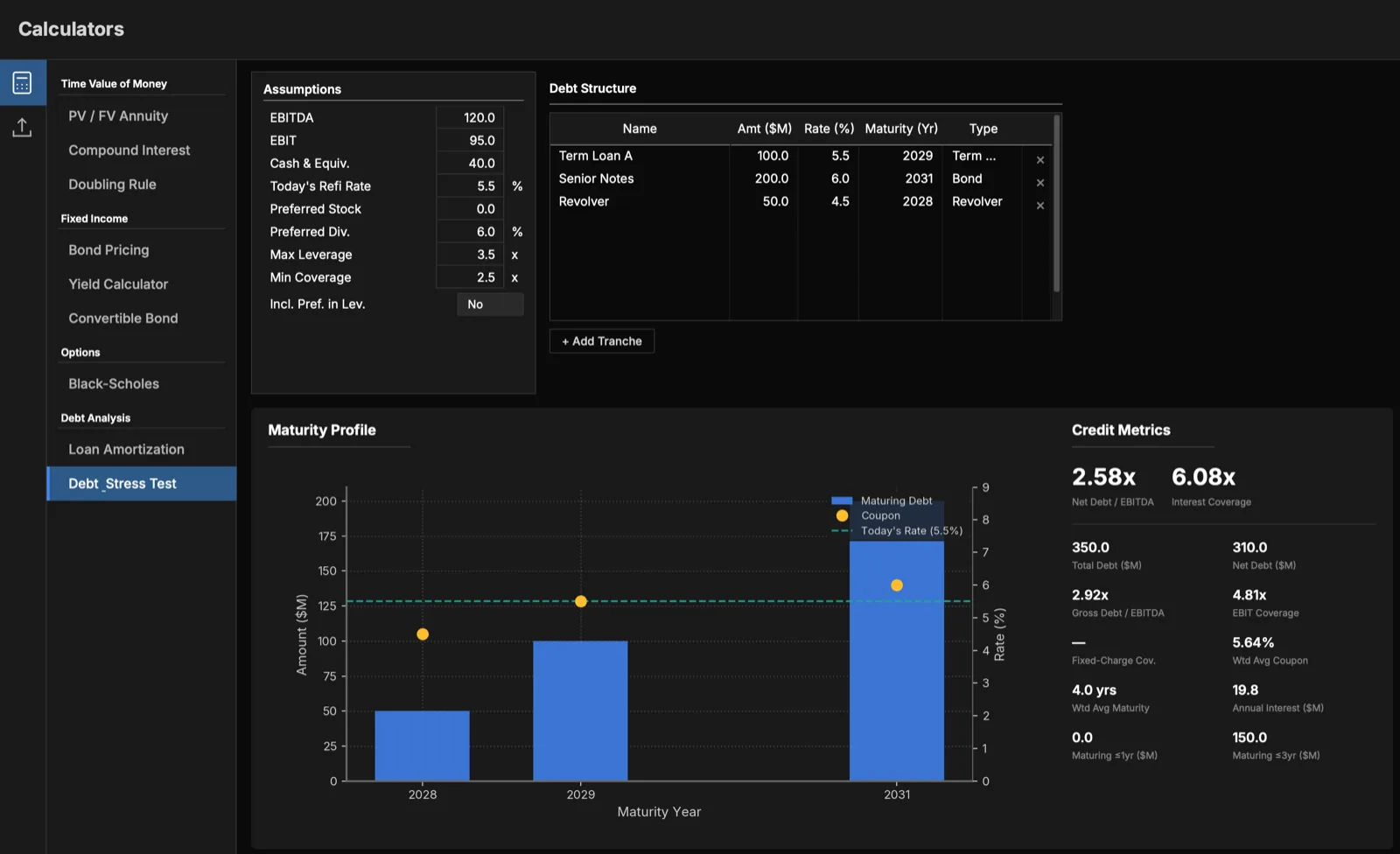
- Debt & Stress Test: analyze debt, coverage, and repayment capacity under different scenarios (coming soon).
Export templates
The Export area offers ready-made templates you can download and fill in outside the app.
- Excel templates: DCF Valuation Model, Comparable Company Analysis, Credit Analysis, Earnings Model, Three-Statement Model, and Portfolio Attribution.
- PowerPoint templates: Equity Research Pitch, Company Profile, Sector Overview, and Portfolio Review.